Sunday, May 12, 2013

The Loire Valley

After Madame Salade read two very enjoyable blog posts about the Loire Valley: here and here , we decided to explore the area on our drive back down to Aix. The Loire Valley is a gorgeous, lush stretch of land along the Loire River. It is also known as, The Garden of France, due to it's abundance of farms, vineyards, and orchards. The Loire Valley is famous for it's wine and it's several hundred grand chateau which pop up all along the river. We are not exactly sure why the French kings began building their grand homes here (or in many cases, stealing others' grand homes already built), but the nobility soon followed suit and the area became a sort of Hamptons for French nobility in the 15th century. For a time the French court was a nomadic one, travelling from one chateau to another and staying for short periods of time. In fact, King Francis I was travelling for over 8,000 days of his 11,778 day reign.

We made reservations at a hotel in the countryside outside of the beautiful town of Amboise. The hotel, again run by English ex-pats, was the perfect place for our family. It was so perfect that we extended our stay by another night and we would have all loved to stay even longer. The boys were won over when they found lollipops laid out on their beds. We had doors that opened out on to a small patio and a field filled with grazing cows. There was a small play structure for the kids and they even offered picnic basket lunches, a service we took advantage of. When I picture "bucolic," I picture cows grazing in a green pasture filled with buttercup flowers. Add a glass of champagne from literally down the road, and you have the right idea. It was quiet, peaceful, relaxing...ahhh, can we go back now?


While in the Loire Valley, we of course toured a couple of the chateau. The first was Chateau D'Amboise, a chateau right in the heart of town and a favorite residence of the French monarchy due to it's strategic location. King Francis I was raised mostly at this chateau. It was pretty impressive.


Views from the chateau walls:


I was not able to get my own shot from across the river, so here is one from the website, www.chateau-amboise.com:


While walking around the chateau grounds, we entered St. Hubert Chapel, built in 1493. Oh hey, look what we found:


Leonardo da Vinci's grave. We were aware that Leonardo died in France, but really? Stumbling onto the guy's grave? That's how this family rolls! He was apparently a very close friend of King Francis I, who gave Leo the honor of being buried at his home.

After touring the Chateau D'Amboise, we decided to walk up the street to Leonardo da Vinci's home in Amboise, called the The Chateau du Close Lucé:


We walked around the outside of the home. You can pay to enter, but we did not. We had another chateau on our list for the day and needed to get going.

We left Amboise and drove to the incredible Chateau de Chenonceau. There are so many beautiful chateau in the area available to tour, but this is a chateau built over water that we had seen many pictures of. It's just gorgeous. It was built on the site of an old mill, sometime before the 11th century, and they must not have been able to get it just right because they kept adding on and remodeling for the next few hundred years. It was given as a gift from King Henri II to his favorite mistress, Diane de Poitiers. She must have been really something. When the King died in 1559, his disgruntled widow, Catherine de'Medici, promptly booted Diane out of Chateau de Chenonceau and took up residence there herself. Catherine was known to throw magnificent, expensive parties here, with fireworks over the river. It passed through several members of the royal family and was saved during the French Revolution (the chapel was saved by boarding the walls and disguising it as a wood store). The kids especially enjoyed the extensive gardens, complete with a maze of bushes. They were pretty proud of themselves for finding the way through.


This was one of our favorite rooms, a hall known as, "The Gallery". It was officially opened by Catherine de' Medici in 1577 and used as a ballroom. It was used as a hospital during WWI. Out each window is a view over the river:


Catherine De' Medici's bedroom, decorated with a rare set of Flanders tapestries, illustrating the life of Samson:


The amazing Renaissance fireplace in Francis I's Drawing Room:


We loved our stay in the Loire Valley and hope to go back one day. Although touristy, the pace is slow and easy. The clean air, open fields, peaceful river, and green vineyards feel a world away from the traffic and noise of Paris. It was a trip good for the soul.

Saturday, May 11, 2013

Moulin á Vent de Moidrey and Mont-St-Michel

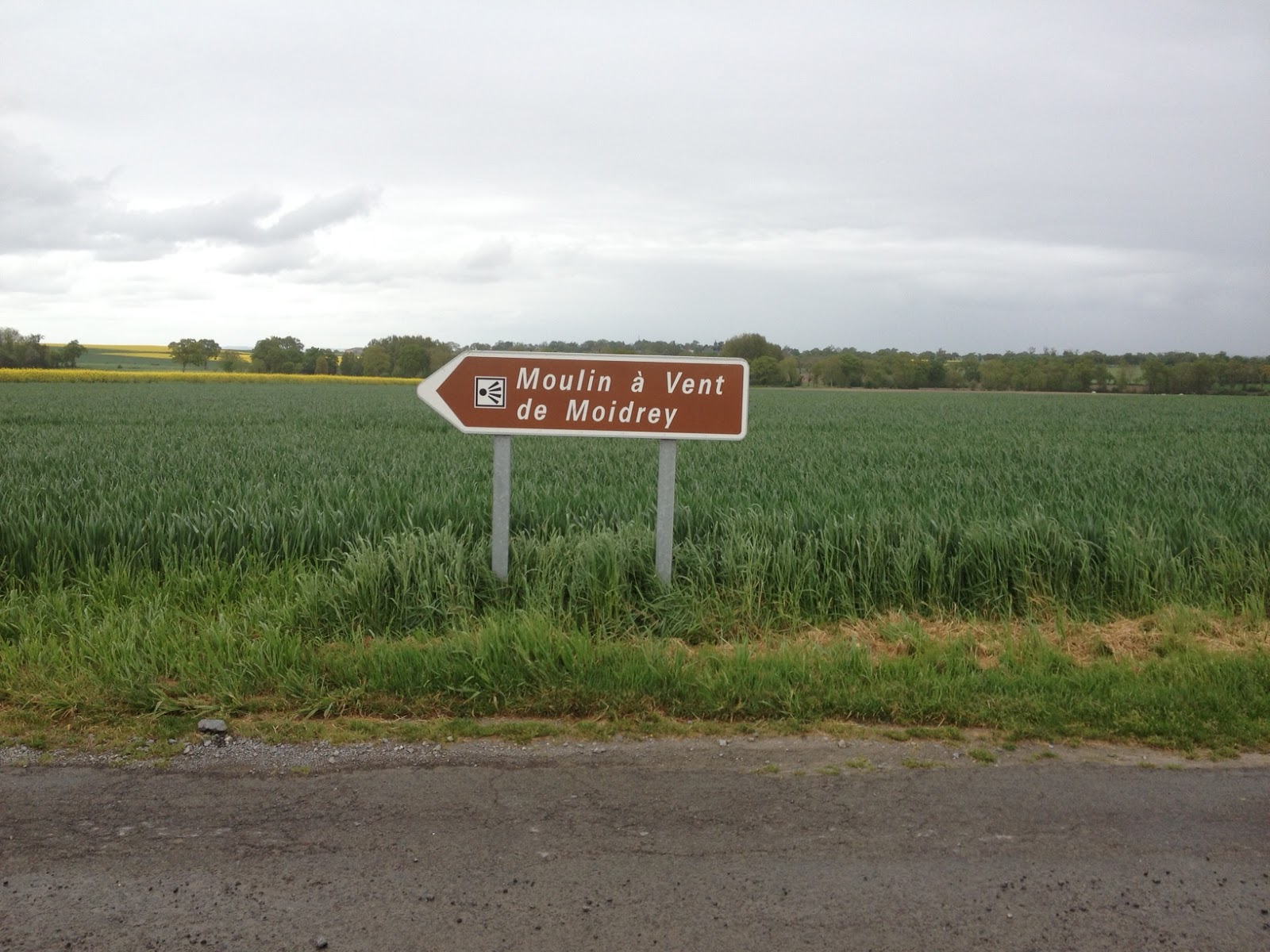
We left Bayeux in the rain and headed towards one of France's busiest attractions, the island of Mont-St-Michel. While Monsieur Bacon was zoned out behind the wheel, we missed our turn. With no way to turn around, we headed down the road looking for the next road going in that direction. What is that thing poking out from that field on the horizon? A windmill? Is that a windmill actually turning? We took a tiny country rode towards Don Quixote's beast, picking our way across the countryside on unnamed roads to find it.

Did you know the countryside of Northern France is covered in canola? We had no idea before we came. It's really pretty. We were surprised to see the mill was open to tour and even more surprised to see it is still a working flour mill, the only one in the area. The mill was built in 1806 and restored about a decade ago. It was really fun to see. Thank God for wrong turns!


People really made some amazing inventions to make life easier!  The roof supports the blades, or "sails," and the entire roof sits on rails so the miller can turn the blades into the wind. The wind turns a shaft running into a big wooden cog, which then turns a shaft running down to a stone flour mill. All sorts of accessories can be powered by the wind as well, from a winch to lift wheat sacks up to the top floor, to a sifting screen to sift the flour, all powered by the wind.

After touring the mill, we drove on to Mont-St-Michel. Rosemary had told us it was very busy and touristy, but once you "climb to the top", it is really amazing. It was late in the afternoon, raining, and getting colder, and the kids were asleep. We turned in to the packed parking lot to catch a shuttle to the island, but decided to skip it altogether. It just didn't sound fun. We parked the car, gazed at the island with it's ancient abbey standing tall, took a couple pictures and journeyed on.  Alone in cool old working windmill? Yes, thank you. Waking up kids so we can wait in line for a shuttle to an island swarming with thousands of other tourists? Next time. We can see it from here this trip.


Friday, May 10, 2013

D-Day Beaches


Our foremost reason for visiting Normandy was a visit to the D-Day beaches. As Americans, we felt a strong desire to pay our respects to those who sacrificed all.  It was a deeply moving and emotional place, to see first hand the scars of war on the ground at Point du Hoc and the rows of white crosses where sons, brothers, and husbands lie.

We set out after breakfast by car from our B&B in Bayeux. It was only about a 15-20 minute drive to the Normandy American Cemetery. We were able to find a parking space easily and got in line to enter the Visitor's Center. Entrance is free, however you must pass through security first which takes a bit of time. The Visitor's Center is simple and very nicely done. The walls are glass, giving a beautiful view of the beaches. The upstairs has a few exhibits on individual soldiers, as well as computers to look up the fallen and where they are buried. Downstairs had exhibits on weapons, equipment, and radios, and a few areas playing videos in English or French. Heading outside, you first pass through a "Hall of Names", where you hear names of the fallen read.


Once outside, we looked over Omaha Beach, where in 1944 the Allied Forces landed for the greatest invasion in history. We know what happened here, but it's still so hard to comprehend.


We had an emotional walk through the cemetery where 9,387 American military are buried. Words can't describe the experience. It was incredibly sad.


We left the cemetery and headed down the coast, before long we found ourselves in an old German bunker. It was amazing to see the vantage point they had. Our boys had a great time running around, theme music going, messing with the machine gun. It was here we began a string of run-ins with a group of American military officers touring the battlefield, which surprisingly, were some of the only Americans we noticed. We heard mostly French, but also some English with British accents, or as Garçon Livre calls it, "London English".


Next, we headed over to the jagged cliffs of the Pointe du Hoc. The evidence of war in this area is startling and horrifying.


At the Pointe du Hoc, a cross honors American Rangers who scaled these cliffs using hooks under heavy enemy fire. Their mission was to destroy the German gun batteries strategically placed here, where they had a vantage of the nearby beaches. The battalion's casualty rate for this mission was greater than 50 percent.


"And the American Rangers began to climb. They shot rope ladders over the face of these cliffs and began to pull themselves up. When one Ranger fell, another would take his place. When one rope was cut, a Ranger would grab another and begin his climb again. They climbed, shot back, and held their footing. Soon, one by one, the Rangers pulled themselves over the top, and in seizing the firm land at the top of these cliffs, they began to seize back the continent of Europe." 
-President Ronald Reagan on the 40th Anniversary of D-Day, June 6, 1984.

Our time in Normandy is an experience we will not forget. Remembering our fallen and seeing our flag made us very homesick. How fortunate and grateful we are to be Americans!

Thursday, May 9, 2013

Bayeux

Another day, another beautiful French village with an incredible history. Next on our trip is the very old town of Bayeux. It's a lovely little town on the River Aure, filled with timbered houses and cobblestone streets. It was founded in the 1st century BC, but evidence of earlier Celtic occupation has been found around the area. Bayeux was an important coastal defense town of the Roman Empire against pirates. It was, of course, later overrun by Vikings. The ducs de Normandie sent their sons to Bayeux in order to learn the Norse language, probably so they could beg for mercy while the Vikings were burning their villages. The city fell in to decline when William the Conqueror set up his capital in nearby Caen. During WWII, Bayeux was spared from bombardment and was the first French town liberated in the Battle of Normandy.

After calling several hotels and finding them all booked, we were finally able to reserve a couple of rooms at a bed and breakfast run by an older English couple who have lived in France for 22 years. They had just returned from a vacation that day and hadn't taken any prior reservations, but they were willing to take ours. Jackpot! Their property was beautiful and the perfect place for the kids to play. Fish, goats, and geese to feed, sheep to count, grass to run on, and a swingset to play on...what could be better? The manor house and old stone barns were fun to explore, imagining just how much hay and grain had to be drug across the stone lintel into the loft over the years to wear it down so much! We had so much fun with Rosemary and "The Colonel". Their witty banter and English colloquialness was such a delight, especially after hearing mostly French for over a month.

The Colonel: "She can make you porridge. It takes but two minutes."

Rosemary: "Well, it takes more than two minutes."

The Colonel: "You mean, it takes YOU more than two minutes."

Rosemary: "That's because I make PROPER PORRIDGE!"

Us: "We're good. We don't need any porridge."

It felt just like staying at your English grandparents' house and it was awesome. It made me miss my own English grandmother so much!


Feeding the geese:


Counting and naming the baby lambs:


Our quarters. A nice upgrade from our tiny hotel in Rouen:


Books in English!


After settling in a bit, we headed in to town:


We took Rosemary's advice and tried a traditional Norman restaurant, "Le Petit Normand", for dinner. Now, let's be honest. One of the best parts about France is the FOOD. It's amazing. It's also very unique in each region of France. Normandy is known especially for apples and hard apple cider. Instead of wine tastings, there are cider tastings. Instead touring wineries, you tour cider farms. They cook meat in cider and use cider in sauces. Apples are everywhere. Normandy also specializes in cream sauces, sea salts, and seafood. At dinner, Monsieur Bacon and Madame Salade tried the cider, of course. It was very good. Monsieur Bacon had lamb in a traditional cream sauce and Madame Salade had a "Pot of Fish" (think chicken pot pie, but instead of chicken it is a variety of seafood: salmon, cod, mussels, and shrimp). The kids had ham and cheese omelettes ( the omelette was invented not far from here!). Although service was painfully slow, we all really enjoyed our meals. It was all great and our kids now adore omelettes.

Outside, we had a lovely view of the town's cathedral, Notre-Dame de Bayeux. The site is very old, once home to Roman sanctuaries. The cathedral itself was consecrated in 1077. It's huge presence towers over the small town of Bayeux. We had the opportunity to tour it on another day and it is truly beautiful. The outside walls of the church are covered in green moss. The inside is bright and airy, much different than most of the old churches we have toured. We were even able to go into the 11th century crypt, painted with artwork from so many centuries ago. So cool! Madame Salade and Monsieur Bacon both commented on how bright it was for such an old church, probably because the stone was lighter and many of the windowpanes were clear glass instead of stained glass. They have also made an unusual effort at maintaining architectural conformity over the years.  Most of the old churches we've seen are easy to spot the additions and refurbishments, but not so here.  It was beautiful.


Another highlight of our time in Bayeux was a visit to their market. They have a very lively market with an array of foods from many different countries (unlike Aix's market) and live animals. Rosemary had suggested a visit to the market and told us it was where she had purchased her geese. The market was busy and a lot of fun. We ended up getting lunch there. We were sad to see the Spanish paella booth already sold out and went with a Moroccan dish of couscous with chicken and veggies after a long and barely understood explanation in French that they were out of lamb. OK? OK. OK? OK, just give us some food, smile and nod. After paying an ice cream seller a euro for utensils, we had a picnic on some steps next to the river. Our Moroccan lunch was out of this world delicious. Everyone in the family enjoyed it. It started drizzling as we ate, so we got in the car and journeyed on from Bayeux.

Jumiéges Abbey Ruins

With no plans to see it until we stopped for gas and saw it listed in a guide book, Jumiéges Abbey was one of our favorite stops. It was a Benedictine abbey founded in 654 by Saint Philibert. Although disrupted by Viking invasions, its importance and size ebbed and flowed, seeing may periods of prosperity and decline until it was finally closed during the French Revolution. It was once renowned for its library and scriptorium and for its charity to the poor. After the Revolution, the abbey was converted into a stone quarry. Today, the abbey is an evocative reminder of the past. It has been called "the most beautiful ruin in France" by many artists and authors. We agree. The abbey was one of the most peaceful, romantic settings for a family walk. We enjoyed spotting the many different architectural styles and time periods. The abbey grounds have plenty of space for the kids to run around and explore. There are sheep and models of Viking ships to look at and also an art gallery located in "The Abbot's Residence", showcasing exhibits mixing ancient and modern pieces of art.


Who cares about old ruins? Let's play with rocks!!!


We left the abbey feeling so grateful to have seen it. They made us pass through the gift shop in order to exit (of course) and the boys found a couple knights on horses figurines. They were well made and very detailed...there goes another 10 euros. Garçon Peanut Butter's rung up as, "King Richard" and Garçon Livre's as, "Prince Phillippe". They have been the best little toys for the boys this trip!

We had another adventure in store for the day...a ferry ride! We drove our car on a ferry and rode across a river. "Mom, we drove our car onto a boat!"